CITY · GUIZHOU
Anshun
安顺 · Ānshùn
Overview
A Guizhou plateau city and gateway to Huangguoshu Falls — China's largest waterfall — and to the Tunpu villages where descendants of Ming-dynasty Han settlers maintain a 600-year-old cultural enclave.
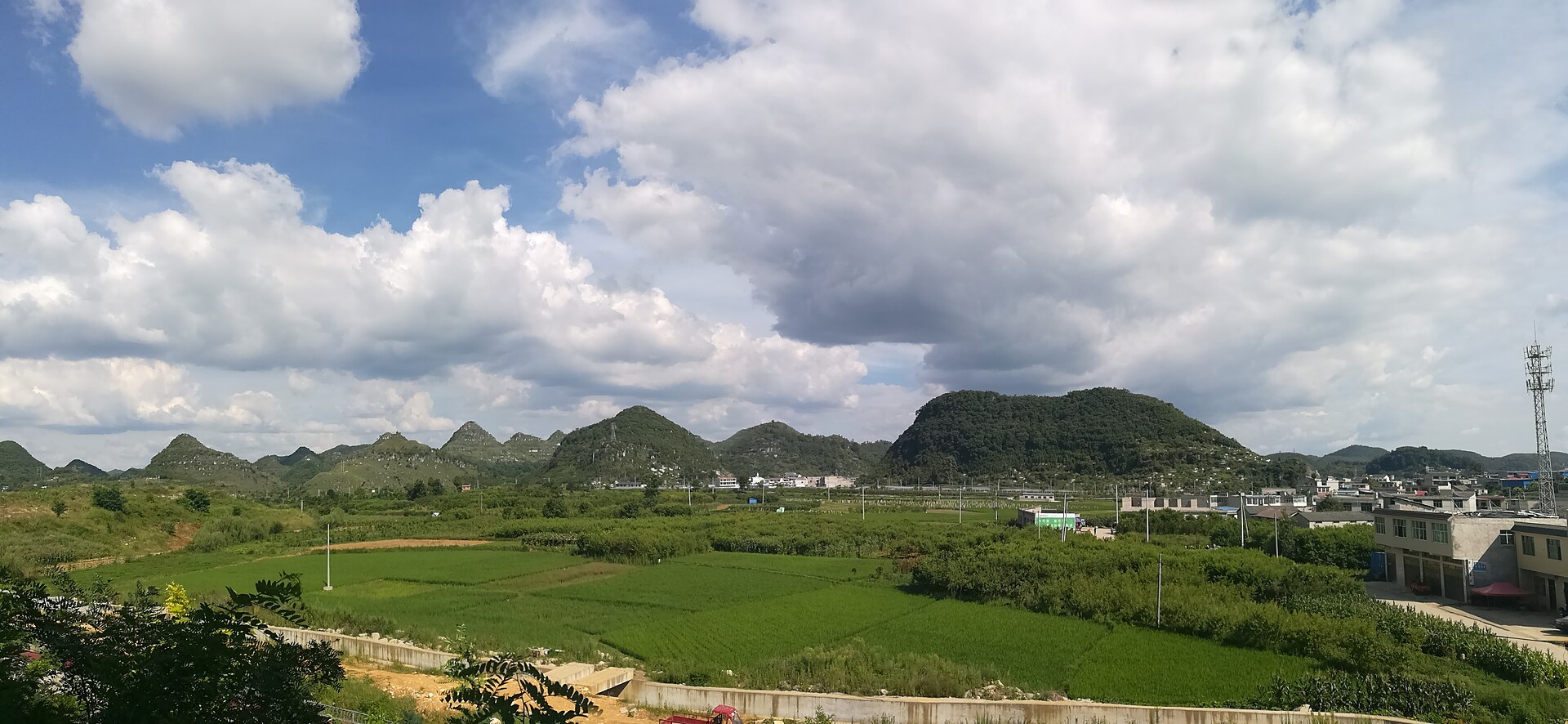
Anshun is a prefecture-level city in central Guizhou province, situated on the Guizhou plateau at approximately 1,380 metres above sea level. Its tourism significance rests on two distinctive assets: the Huangguoshu Waterfall and its surrounding scenic area, and the Tunpu (Earthen Fort) villages of the surrounding countryside.
Huangguoshu Falls is China's largest waterfall, with a drop of 77 metres and a width of 101 metres. The water falls into Rhinoceros Pool below and the falls can be entered from behind through a natural cave system. The scenic area around Huangguoshu includes a series of smaller falls, gorges, and karst formations typical of the Guizhou limestone landscape. The falls are at their highest volume in summer and autumn following the monsoon rains.
The Tunpu villages represent a different kind of uniqueness: they were established in the late 14th century when the Hongwu Emperor (first emperor of the Ming dynasty) settled soldiers and their families in Guizhou to consolidate control over the newly conquered southwest. Over 600 years, these Han settlers developed a distinct sub-culture — the Tunpu people — who maintained Ming-dynasty dress, architecture, customs and performing arts largely unchanged from the moment of settlement. Tunpu women still wear the hairstyle, blue pleated skirts and embroidered smocks of the Ming court ladies; the Dixi face-mask drama is a form of masked military opera unique to the Tunpu communities.
Anshun is 100 km west of Guiyang on the high-speed rail line and is easily visited as a two-day side trip from the provincial capital.
Cultural & access notes
The Tunpu people are Han Chinese but maintain a 600-year-old cultural enclave distinct from modern Han culture. Their dress and customs are not a performance of a minority culture but a preserved form of Han tradition. The Dixi opera is performed during specific festival periods; attending a genuine festival performance rather than a tourist demonstration is more meaningful.
What to see
- Huangguoshu Falls — China's largest waterfall, accessible from the front viewing platform and the behind-the-falls cave
- Doupotang Falls — a series of falls downstream from Huangguoshu, less visited and calmer
- Tunpu villages — Tianlong, Ben'guan, Yunshan — the Ming-descendant communities with preserved dress and architecture
- Dixi face-mask opera — the Tunpu military mask drama, performed at community festivals and some tourist demonstrations
- Anshun wax-resist batik — the city is a centre of traditional blue-and-white batik production
- Longpan Gorge — a karst canyon scenic area south of the city
What to eat
- Guizhou sour soup — fermented tomato and chilli base used for fish, tofu and vegetable dishes
- Anshun cold rice noodles (si wa wa) — hand-wrapped fresh rice noodle rolls
- Goat offal soup — a local morning breakfast dish, acquired taste
- Guizhou-style spicy duck neck — popular street snack
- Wax gourd and pork rib soup — a home-style plateau comfort dish
Getting there
Anshun West station is on the Shanghai-Kunming high-speed rail line. From Guiyang approximately 30 minutes; from Kunming approximately 3.5 hours. Huangguoshu scenic area is 45 km from Anshun city centre by tourist bus or taxi (about 1 hour). The nearest airport is Guiyang Longdongbao International Airport (KWE).
Getting around
Tourist buses connect Anshun city to Huangguoshu and the Tunpu village cluster. Taxis and hired vehicles cover the wider area. The Tunpu villages are clustered and a half-day circuit by hired vehicle covers the main ones.
Where to stay
Anshun city has a range of standard Chinese hotels. Guesthouses are available in some Tunpu villages for an immersive stay. Staying in Anshun is more convenient for early-morning transport to the falls.
We list neighbourhoods, not specific hotels — we don't endorse hotels.
When to go
April–June and September–October are the best months. The falls are most powerful June–October after the monsoon rains. Spring (April–May) is the best period for the Tunpu festivals and outdoor temperatures. Winter is cool but the falls remain accessible.
Budget guide (CNY per day)
| Backpacker | ¥180 |
| Mid-range | ¥380 |
| Comfortable | ¥750 |
Safety notes
The area behind Huangguoshu Falls is accessible by path and is genuinely wet — waterproof clothing or the ponchos available for rent at the entrance are necessary. The path surfaces are slippery when wet. Tourist bus driving standards on the mountain roads vary.
Other cities in Guizhou
- Guiyang贵阳
Capital of Guizhou, gateway to the Miao and Dong ethnic-minority villages and to the Huangguoshu Waterfall — China's largest. Cool mountain climate, sour and spicy local cooking.
- Kaili凯里
The hub city of Guizhou's Miao minority heartland, gateway to hundreds of traditional Miao and Dong villages and one of the densest concentrations of ethnic minority textile, silver and music cultures in China.
- Tongren铜仁
A Guizhou prefecture-level city and gateway to Fanjingshan — a sacred Buddhist mountain and UNESCO World Heritage Site with a remarkable double-peak rock formation rising above primeval forest.
- Xijiang Qianhu Miao Village西江千户苗寨
The largest Miao village in the world — approximately 1,200 households of stacked wooden stilt houses covering a mountain valley in Guizhou — a living community and Guizhou's single most visited tourist site.
- Zhaoxing肇兴
The largest Dong village in China, with five timber drum towers, covered wind-and-rain bridges, and an intact living Dong culture in the mountains of southeastern Guizhou.
Food of Southwestern China
- Baba Flatbread粑粑
Yunnan's daily flatbread — a thick wheat or rice-flour round cooked on a griddle and eaten plain or stuffed.
- Bang Bang Chicken棒棒鸡
Cold poached chicken shredded by hand, dressed in chilli oil, sesame paste and Sichuan peppercorn.
- Boiled Fish in Chilli Oil水煮鱼
Fish slices submerged in a deep pool of chilli oil and Sichuan peppercorns. Served bubbling.
- Chongqing Hotpot重庆火锅
The original mala hotpot — a simmering cauldron of beef tallow, Pixian doubanjiang and Sichuan peppercorn for communal dipping.
Anshun weather by month
| Month | Jan | Feb | Mar | Apr | May | Jun | Jul | Aug | Sep | Oct | Nov | Dec |
|---|---|---|---|---|---|---|---|---|---|---|---|---|
| High °C | 9 | 12 | 17 | 20 | 23 | 25 | 26 | 26 | 24 | 19 | 16 | 10 |
| Low °C | 2 | 4 | 9 | 11 | 15 | 18 | 19 | 19 | 16 | 12 | 8 | 3 |
| Rain mm | 57 | 65 | 86 | 119 | 192 | 325 | 221 | 167 | 183 | 106 | 62 | 29 |
| Rain days | 15 | 17 | 19 | 19 | 21 | 23 | 22 | 21 | 17 | 16 | 14 | 10 |
2019–2023 average via Open-Meteo ERA5 (ERA5 reanalysis). "Rain days" = days per month with ≥1 mm precipitation.
Frequently asked questions
- When is the best time to visit Anshun?
- The best months to visit Anshun are April, May, June, September, and October. April–June and September–October are the best months. The falls are most powerful June–October after the monsoon rains.
- How many days do you need in Anshun?
- Plan 3 days for Anshun if you want to see the headline sights without rushing — Huangguoshu Falls, Doupotang Falls, Tunpu villages. Add an extra day for day trips from the city or for repeat visits to your favourite neighbourhood.
- Is Anshun safe for tourists?
- The area behind Huangguoshu Falls is accessible by path and is genuinely wet — waterproof clothing or the ponchos available for rent at the entrance are necessary. The path surfaces are slippery when wet. Tourist bus driving standards on the mountain roads vary.
- How do you get around Anshun?
- Tourist buses connect Anshun city to Huangguoshu and the Tunpu village cluster. Taxis and hired vehicles cover the wider area. The Tunpu villages are clustered and a half-day circuit by hired vehicle covers the main ones.
- What's the daily budget for Anshun?
- Budget guide for Anshun: backpackers from around ¥180/day, mid-range travellers ¥380/day, comfortable trips from ¥750/day. These ranges cover accommodation, food, local transport and one paid sight per day, and exclude flights to and from the city.
- Where should you stay in Anshun?
- Anshun city has a range of standard Chinese hotels. Guesthouses are available in some Tunpu villages for an immersive stay. Staying in Anshun is more convenient for early-morning transport to the falls.
Spotted something out of date? Submit a correction.
Research
Cross-checked against primary sources
Verified
Address, hours, fees confirmed at the date shown
Updated
Re-verified periodically; corrections welcome